
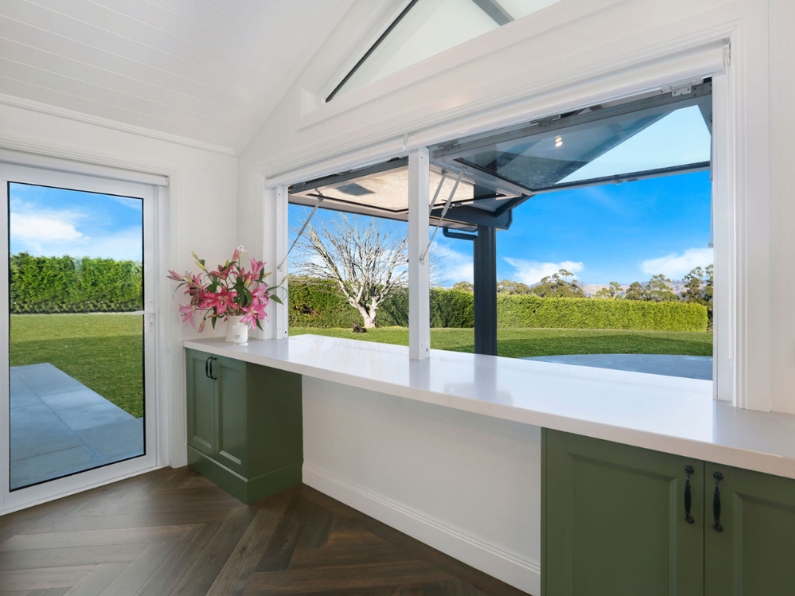
Upgrading your kitchen with servery windows can be surprisingly simple. The key is choosing the right styles, setting comfortable bench heights, and selecting the right glass for privacy and temperature control. When these basics come together, even a small kitchen can reflect thoughtful utility.
Why Upgrade?
There is a point in most kitchens where everything functions… but it does not flow. The light might be uneven, the air slightly heavy while cooking, or the window facing outside feels under-utilised.
A thoughtful window upgrade or a smart modification can refresh the space without the clutter. And servery windows are one of the best elements to consider in these cases.
A Quick Glance At What We’re Going To Discuss
| You’ll Discover | Why It Matters | How It Impacts Your Outcome |
| Placement Decisions | Avoids awkward layouts or blocked walkways | Improves natural flow between spaces |
| Size & Proportion | Prevents overcrowding or under-utilisation | Makes the opening feel intentional, not forced |
| Upgrade vs New Installation | To understand the investment | See the possibility of small upgrades to save you $$ |
| Elements That Affect Your Practical Daily Use | Ensures the feature is indeed used regularly | Increases long-term satisfaction |
| Structural & Safety Factors | Prevents costly corrections later | Protects both property and occupants |
1. Will This Work If My Kitchen Faces a Patio, Balcony, or Internal Dining Area?
Many people assume that servery upgrades only suit outdoor entertaining zones, but that is not always the case.
For patio-facing kitchens, aluminium servery windows provide durability and ease of movement. For balconies or apartments, a sliding servery window avoids outward protrusion and keeps circulation clear.
This is effective for passing items or maintaining safe visibility with kids without full contact with hot elements or cooking spillovers.
2. Will a Bigger Window Make Your Kitchen Too Hot or Too Bright?
Many people hesitate to enlarge a window because they worry about overheating the room or losing comfort during summer.
Gas strut servery windows are helpful when the wall height is higher and upward lifting feels more natural. They convince you that sliding servery windows suit tight kitchens where swing space is limited. These aspects help you gain better control over the airflow and the incoming sunlight.
And because aluminium windows are lightweight yet strong, these mechanisms remain smooth even with frequent daily use. Homeowners often notice that the right style reduces awkward reaching or leaning, making interaction feel natural rather than forced.
3. Can I Modify Existing Servery Windows or Do I Need a New One?
Most kitchens already have a window in the right wall, but it just may not open wide enough or feel practical. In such cases, the upgrade involves widening the current frame slightly or changing the opening mechanism rather than demolishing the wall.
A sliding servery window remains popular because it usually fits into existing spaces with less fuss. A careful inspection by experts can help you make an informed decision.
For homeowners, this noticeable improvement in light and accessibility means the kitchen feels refreshed, yet familiar.
4. What If Wall Space Is Limited or My Kitchen Is Small?
Not every home layout works the same way, and the opening style can change how comfortable the space feels. In fact, limited wall space is where smart servery window design shows the most value.
A compact sliding servery window can sit neatly above a benchtop while still allowing comfortable hand-to-hand interaction.
For homeowners in townhouses or narrow suburban homes, this upgrades the space utilisation experience.
5. Want a Subtle Improvement Over a Big Renovation?
Many homeowners simply want smoother interaction between spaces without altering the entire kitchen identity. This is where upgrading mechanisms, widening slightly, or shifting to aluminium servery windows becomes valuable.
Aluminium windows allow this refinement because they integrate easily with existing structures. You get noticeable benefits without the chaos of a full remodel.
Smarter Kitchen Upgrades Are Here
Upgrading your kitchen with servery windows means retaining the dimensions, improving the performance.
Modern aluminium servery windows are designed to allow you to open up true possibilities. And our team at B&W Windows Group can help you achieve that.
Call (02) 9540 2500 to discuss more or visit our Caringbah showroom to see these 5 tips in action.
FAQs
Q. How much does it cost to install a servery window in Australia?
Costs vary based on size, wall structure, and window type. A basic upgrade can start in the low thousands, while larger structural changes increase the budget.
Q. Which type of servery window is best for small kitchens?
Sliding servery windows are often preferred in compact kitchens because they do not require swing space and fit neatly above benchtops without crowding the wall.
Q. Can a servery window be installed in a load-bearing wall?
Yes, but it requires professional assessment and structural support, such as a lintel. This ensures safety and compliance with building standards.
Q. Are servery windows suitable for apartments or units?
Yes, especially sliding styles. They work well between kitchens and balconies or internal dining areas where outward-opening designs may not be practical.
Q. Are servery windows safe for homes with children?
Yes, when fitted with proper locks, smooth mechanisms, and appropriate height placement. Safety features can be added for extra reassurance.
Q. What is the best placement for a servery window in a kitchen?
The ideal placement is usually above a benchtop that already faces a patio, balcony or dining area, allowing natural interaction without disrupting cabinets or appliances.
Q. How wide should a servery window opening be?
There is no fixed rule. Many homeowners choose widths between 1200 mm and 2400 mm, depending on wall size and how frequently the opening will be used.